


Vesugen Peptide: How It Works, Benefits & Uses
The vesugen peptide is a short synthetic peptide bioregulator from the Khavinson research tradition, designed as a blood vessel bioregulator to support the vascular system. This guide explains what Vesugen is, how it is thought to work on the endothelium, its benefits, dosage and cycling, the role of vesugen acetate, safety, and where to find Vesugen for sale safely.
Editorial & research disclaimer: This article is for educational purposes only and is not medical advice. Vesugen is a peptide bioregulator and has not been evaluated by the FDA to diagnose, treat, cure, or prevent any disease, including cardiovascular disease. Always consult a licensed healthcare professional and verify local regulations before using any peptide.

Quick Answer
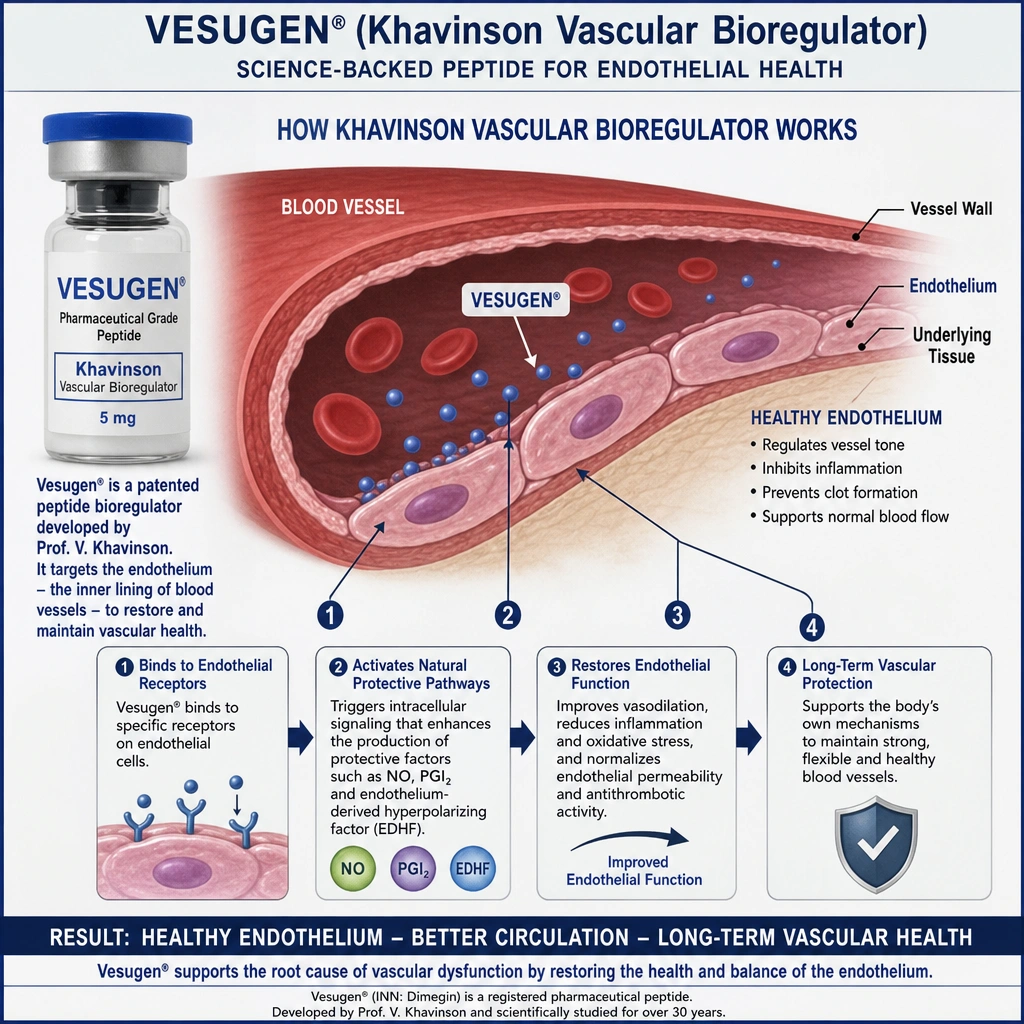
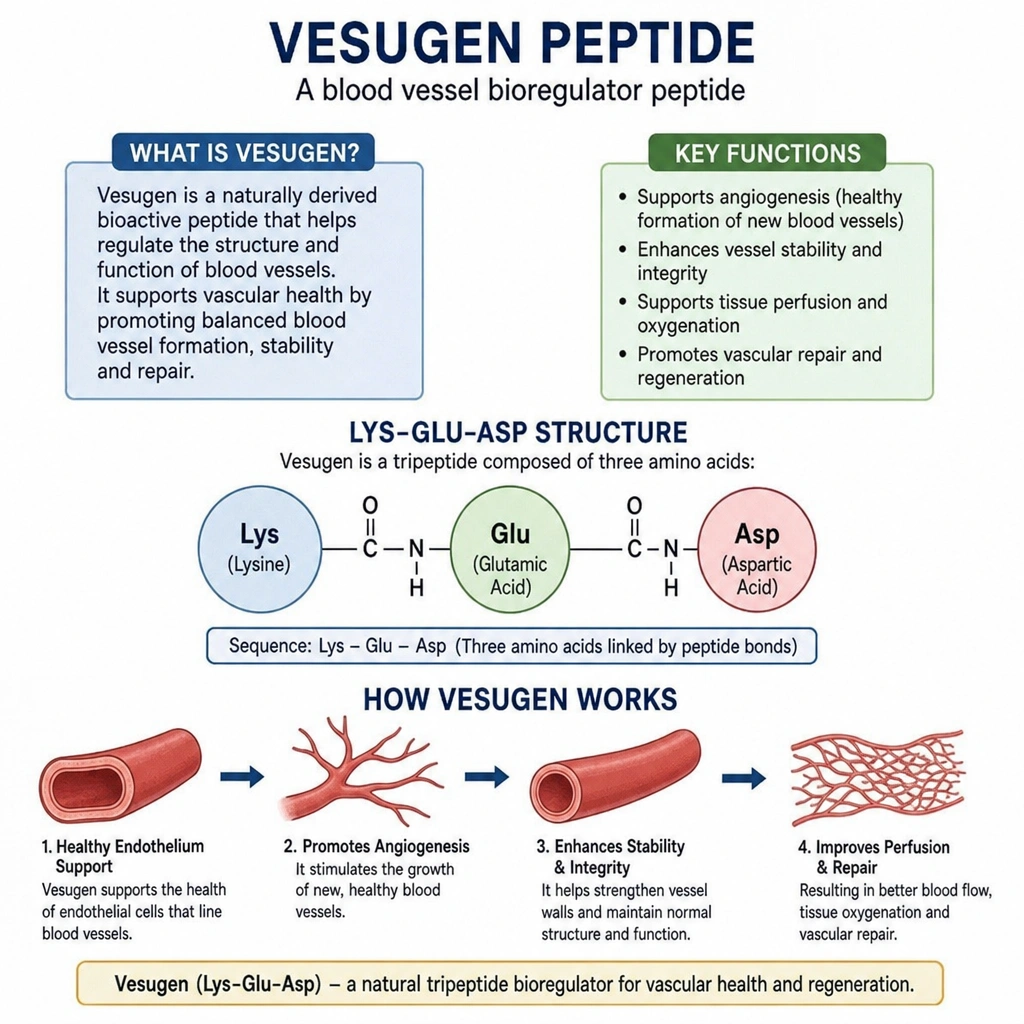
What is Vesugen peptide? Vesugen is a synthesized peptide bioregulator (a "cytogen") formulated to target the vascular system. It is the tripeptide Lysine-Glutamic acid-Aspartic acid (Lys-Glu-Asp / KED). In the Khavinson model it acts as an epigenetic switch for epigenetic regulation — entering vascular cells, reaching the nucleus, and modulating gene expression to maintain vascular health, vascular integrity, blood-vessel structure, and the extracellular matrix, especially the endothelium.
As a blood vessel peptide bioregulator it is used in cycles and sold as oral capsules or sublingual drops (often as vesugen acetate, the stabilized salt form). Evidence is largely preclinical and from its originating research school, so treat Vesugen as an educational, research-grade compound rather than an approved medicine.
Vesugen is a Khavinson-class blood vessel bioregulator — the tripeptide Lys-Glu-Asp studied for vascular support, not an approved drug.
Mechanism is epigenetic by hypothesis: it is proposed to restore endothelial function and nitric-oxide production, improve vessel-wall elasticity, and strengthen capillaries.
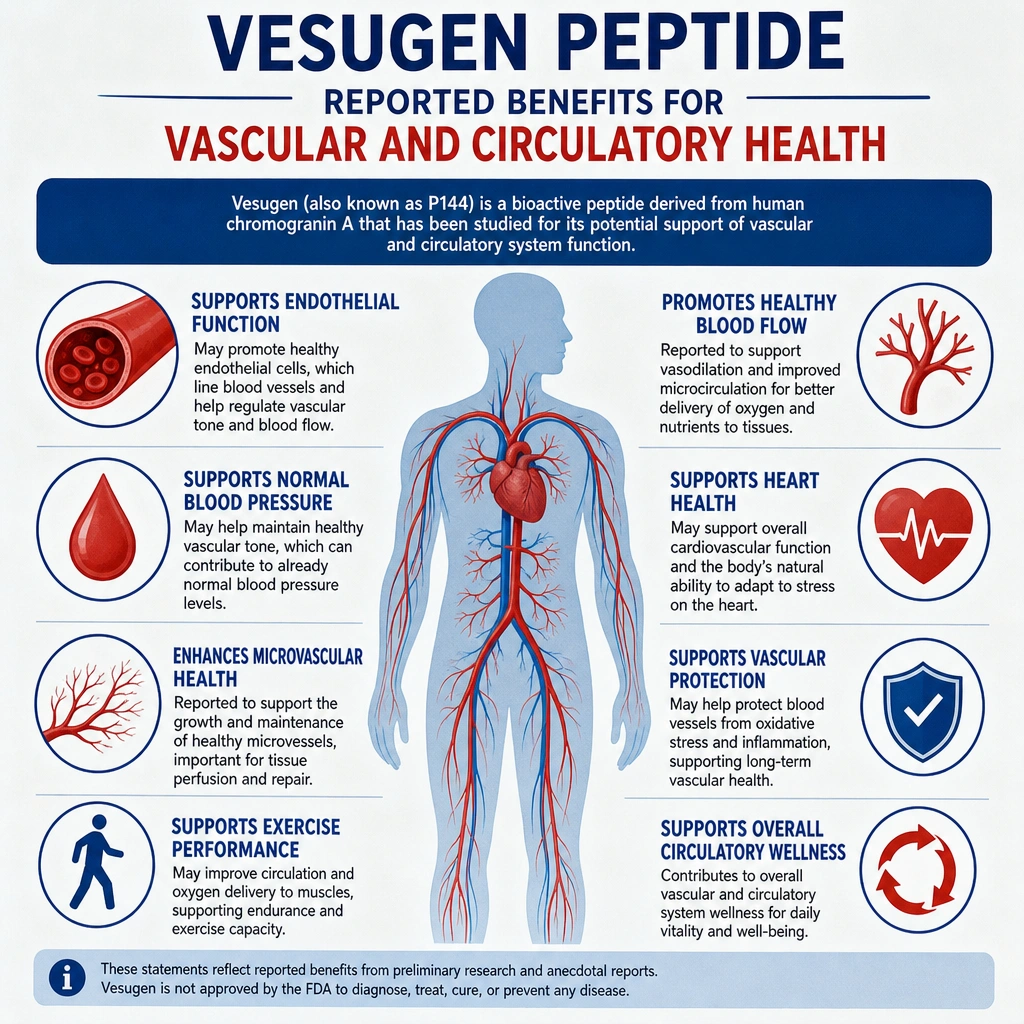
Reported vesugen peptide benefits include cardiovascular rejuvenation, better microcirculation, atherosclerosis-prevention support, and brain-blood-flow support without significant prooxidant activity — mostly from preclinical and originating-school data.
Vesugen peptide dosage is typically 1-2 capsules (100-200 mcg) daily in 10-30 day cycles, repeated every 3-6 months; vesugen acetate is the stabilized form.
Buy on proof. Choose Vesugen from suppliers with third-party COAs and clear Lys-Glu-Asp labeling; confirm legality in your region.
What Is the Vesugen Peptide?
At its core, the vesugen peptide is a synthesized bioregulator formulated to target the vascular system — a true blood vessel bioregulator. Because it is a "cytogen," Vesugen is made in a laboratory to mirror the exact biological triggers for blood-vessel regeneration and provide geroprotective effects to combat cellular aging. It belongs to the family of Khavinson bioregulators and is prized as a fast-acting vesugen bioregulator for initiating vascular repair.
The Chemical Structure: Lys-Glu-Asp Tripeptide
Vesugen is very small — a tripeptide with the sequence Lysine, Glutamic acid, Aspartic acid (Lys-Glu-Asp / KED) that may interact with pathways like SIRT1 and has a specific molecular formula designed for high cellular permeability. The Lys-Glu-Asp tripeptide benefits come from its tiny molecular weight: it can pass through the digestive tract, penetrate vascular-cell membranes, and enter the nucleus, where the sequence is proposed to act as a key that unlocks genes governing blood-vessel integrity. This is why it is often described as a blood vessel peptide bioregulator, or a vesugen peptide bioregulator for blood vessels.
What Is Vesugen Acetate?
You will often see the compound listed as vesugen acetate. Peptides are commonly bonded with an acetate salt to stabilize the molecule — this extends shelf life and supports bioavailability whether taken orally, sublingually, or (in clinical settings) by injection.
How Does Vesugen Work?
Vesugen is not a temporary vasodilator like a blood-pressure pill; in the Khavinson model it is proposed to structurally support the vascular system from the inside out. Three mechanisms are emphasized:
- Repairing the endothelium: the single-cell lining that releases nitric oxide (which relaxes vessels) and regulates vasoconstrictors like endothelin-1. Vesugen is proposed to stimulate protein synthesis and endothelial cell proliferation in vascular endothelial cells and regulate apoptosis, supporting nitric-oxide production while potentially modulating endothelin-1 levels and reducing oxidative stress or harmful prooxidant activity.
- Improving vessel-wall elasticity: by normalizing metabolism in vascular smooth muscle and the extracellular matrix, it is proposed to support youthful flexibility against age and glycation.
- Strengthening capillary walls: reinforcing the microvasculature that delivers oxygen and nutrients to skin, eyes, and brain.
These are mechanistic, largely preclinical observations, not proven human outcomes.
Vesugen Peptide Benefits
Because the vascular system feeds every organ, including the immune system, the reported vesugen benefits are broad (evidence is largely preclinical and from its originating research school):
- Cardiovascular rejuvenation: more elastic, responsive vessels may reduce the heart's workload.
- Microcirculation support: better capillary flow is linked to energy, skin tone, and cellular detox.
- Atherosclerosis-prevention support: it cannot dissolve calcified plaque, but a smooth, healthy endothelium may resist new plaque formation.
- Blood-pressure support: not a drug that lowers pressure, but improved elasticity may ease mechanical resistance.
- Brain and cognition: restoring cerebral blood flow is proposed to support clarity and focus.
Who Benefits Most: Use Cases
Groups often highlighted include adults over 40 pursuing anti-aging vascular therapy, individuals managing vascular aspects of metabolic syndrome, athletes optimizing blood flow and recovery, high-stress professionals repairing stress-related vascular strain, and people recovering from illness or surgery who need robust microcirculation. Specific applications discussed include chronic venous insufficiency and varicose-vein support, ocular/retinal microcirculation, organic brain syndrome, post-viral (including post-COVID) endothelial repair, potential support against restenosis, and skin-health synergy with cosmetic treatments.
Vesugen vs. Ventfort: Cytogen vs. Cytomax
Understanding the cytogens-vs-cytomaxes distinction helps you plan a protocol. Vesugen (a synthetic cytogen) acts quickly; Ventfort (a natural vascular cytomax) acts more slowly but lasts longer. Many pair them in a "Fast & Slow" stack.
| Factor | Vesugen (Cytogen) | Ventfort (Cytomax) |
|---|---|---|
| Type | Synthetic tripeptide (Lys-Glu-Asp) | Natural vascular extract |
| Target | Blood vessels / endothelium | Blood vessels / vascular tissue |
| Onset | Rapid | Slower, gradual |
| Duration | Initiates repair (shorter) | Consolidates (longer) |
| Typical role | Kickstart (days 1-10) | Follow-on (days 11-40) |
| Form | Capsules / sublingual (vesugen acetate) | Capsules |
Vesugen Peptide Dosage and Administration
Because Vesugen is not an approved medicine, there is no official human dose. The vesugen peptide dosage guidance below comes from bioregulator literature and should be treated as research parameters only. A common question is vesugen peptide injection cycle length and mg per day; note that oral and sublingual routes are standard for consumer use, with injectables mainly clinical.
- Choose the form — oral capsules or sublingual drops/sprays (often vesugen acetate); injectables are used mainly in clinical settings.
- Intensive protocol — 2 capsules daily (about 100-200 mcg total) for 30 days.
- Timing — take in the morning, 15-30 minutes before a meal.
- Maintenance — 1-2 capsules daily for 10-20 days.
- Cycle frequency — repeat intensive cycles every 3-4 months, or maintenance every 6 months.
Stacking Vesugen (Chelohart & Pinealon)
Because organs rely on one another, Vesugen is often stacked with other bioregulators:
- "Fast & Slow" vascular: Vesugen (days 1-10) then Ventfort (days 11-40).
- Cardiovascular powerhouse: Vesugen (blood vessels) + Chelohart (heart-muscle peptide) for 30 days.
- CNS & microcirculation: Vesugen (vascular) + Cerluten or Pinealon (brain peptides).
What is Pinealon? Pinealon is a brain/CNS bioregulator (the tripeptide Lys-Glu-Asp-Trp) targeting the central nervous system and is frequently paired with Vesugen. Reported pinealon benefits center on cognitive function, focus, and neuroprotective effects in the context of Alzheimer’s disease, and the pinealon peptides literature describes a favorable safety profile with minimal pinealon side effects — the same "well-tolerated short peptide" pattern seen across this family. Pairing a vascular peptide with a brain peptide is proposed to deliver both the oxygen (Vesugen) and the repair signal (Pinealon) that neural tissue needs.
Safety and Side Effects
Decades of research from the St. Petersburg Institute (Professor Vladimir Khavinson's work) report a strong safety profile for bioregulatory peptides, with a low incidence of adverse effects — Vesugen is a small chain of amino acids the body recognizes. Independent, large-scale human trials are limited, so read these reports as encouraging rather than definitive.
Precautions: consult a healthcare provider before use, especially if you are pregnant, nursing, or taking prescription blood-pressure medication, since improved vascular function could interact with how those medications are dosed.
Where to Find Vesugen for Sale Safely
Rising popularity has brought counterfeit and under-dosed products. When navigating vesugen for sale, buy on documentation.
| Factor | High-Quality (Verified) | Low-Quality / Risky |
|---|---|---|
| Testing / COA | Third-party Certificate of Analysis | Missing or generic |
| Sourcing | Authorized Khavinson distributor | Unknown origin |
| Labeling | States Lys-Glu-Asp sequence | Vague ingredient list |
| Contaminants | Tested (heavy metals, microbes) | Untested |
| Price | Reflects real synthesis cost | Suspiciously cheap (filler risk) |
You can use PrymaLab's bioregulator catalog as a reference point for the transparency standards a trustworthy supplier should meet.
Related searches: blood vessel peptide, blood vessel peptide bioregulator, vesugen peptide bioregulator, vesugen peptide bioregulator blood vessels, vesugen peptide injection cycle length mg per day, what is pinealon peptide, pinealon peptides, and pinealon side effects.
Researching vascular bioregulators? Start with verified material.
PrymaLab focuses on US-handled research peptides with transparent documentation and careful handling.
Explore PrymaLab BioregulatorsFrequently Asked Questions
What is Vesugen and what does it do?
Vesugen is a synthetic peptide bioregulator (a cytogen) made of the tripeptide Lys-Glu-Asp that targets the vascular system. In the Khavinson model it acts as a blood vessel bioregulator, entering vascular cells to support endothelial repair, nitric-oxide production, vessel-wall elasticity, and capillary strength. It is used as an educational, research-grade compound rather than an approved medicine.
What are the main Vesugen peptide benefits?
Reported vesugen peptide benefits include cardiovascular rejuvenation from more elastic vessels, improved microcirculation, support against new atherosclerotic plaque, gentler blood-pressure regulation through elasticity, and better cerebral blood flow for focus. Evidence is largely preclinical and from its originating research school, so strong disease claims should be treated cautiously.
What is the typical Vesugen peptide dosage?
A common vesugen peptide dosage is 2 capsules daily (about 100-200 mcg total) for 30 days, taken in the morning 15-30 minutes before a meal, repeated every 3-4 months; a maintenance option is 1-2 capsules daily for 10-20 days every six months. Oral and sublingual routes are standard; injectables are mainly clinical. These are research parameters only.
What is vesugen acetate?
Vesugen acetate is the acetate-salt form of the Vesugen peptide. Peptides are frequently bonded with an acetate salt to stabilize the molecule, which extends shelf life and supports bioavailability whether the peptide is taken orally, sublingually, or by injection. Functionally it is the same Lys-Glu-Asp vascular bioregulator in a stabilized form.
Is Vesugen safe, and are there side effects?
Research from the St. Petersburg Institute reports a strong safety profile for bioregulatory peptides, with a low incidence of adverse effects, since Vesugen is a small amino-acid chain the body recognizes. Independent human trial data are limited. Consult a healthcare provider first, especially if pregnant, nursing, or taking blood-pressure medication.
Can I stack Vesugen with Pinealon?
Yes, a common stack pairs Vesugen (a vascular peptide) with Pinealon (a brain/CNS peptide) for cognitive and microcirculation goals. What is Pinealon? It is a Khavinson brain bioregulator; reported pinealon benefits focus on cognition and neuroprotection, with minimal pinealon side effects noted. The idea is that Vesugen delivers blood flow while Pinealon supports neural repair and neuronal differentiation.
Where can I find Vesugen for sale safely?
Look for vesugen for sale from authorized Khavinson distributors that provide third-party Certificates of Analysis, test for contaminants, and clearly label the Lys-Glu-Asp sequence. Avoid suspiciously cheap or unlabeled products, and confirm the legal status of the compound in your region before buying.
References & Further Reading
- Khavinson, V.Kh. (2002). Peptides and Ageing. Neuroendocrinology Letters, 23(Suppl 3), 11–144.
- Khavinson, V.Kh., & Malinin, V.V. (2005). Gerontological Aspects of Genome Peptide Regulation. Karger, Basel.
- Anisimov, V.N., & Khavinson, V.Kh. (2010). Peptide bioregulation of aging: results and prospects. Biogerontology, 11(2), 139–149.
- Review literature on short peptide bioregulators, endothelial function, and the Lys-Glu-Asp (KED) vascular peptide.
- U.S. Food and Drug Administration. Dietary Supplements: Questions and Answers. FDA.gov. Accessed 2026.
PrymaLab resources: Bioregulator peptides · Research Hub · Peptide calculator · FAQ.
Final disclaimer: This article is for educational purposes only. Vesugen and the other compounds discussed have not been evaluated by the FDA or comparable agencies to diagnose, treat, cure, or prevent any disease, and statements about their effects have not been evaluated by the FDA.
Always consult a licensed healthcare professional before starting any new health protocol, and verify the legal status of any compound in your jurisdiction. PrymaLab does not endorse any specific third-party peptide vendor mentioned in this article and assumes no responsibility for third-party products.